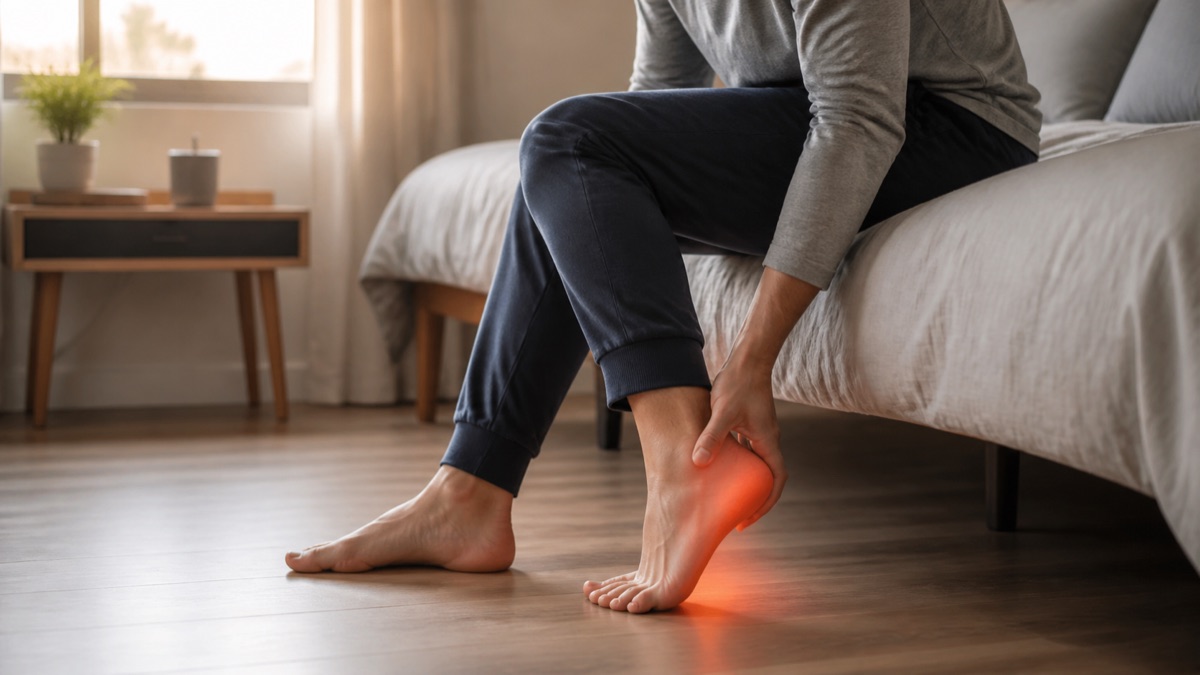
You swing your legs over the side of the bed, plant your feet on the floor — and a sharp, stabbing pain shoots through your heel. Within a few minutes of walking, it fades. Then it comes back the next morning, and the one after that. If this sounds familiar, you are not alone. Morning heel pain is one of the most common complaints I see in my sports medicine podiatry practice at VitaStep, and there is a very precise biomechanical explanation for why it happens exactly at that moment.
What Causes That First-Step Heel Pain?
The plantar fascia is a thick, fibrous band of connective tissue that runs along the bottom of your foot, connecting your heel bone (calcaneus) to the base of your toes. Its job is to act as a bowstring — absorbing shock and supporting the arch with every step you take. During sleep, your foot naturally rests in a plantarflexed position (toes pointed down). In this position, the plantar fascia is in its shortest, most contracted state.
When you stand up in the morning, your foot rapidly dorsiflexes (bends upward), and the contracted fascial tissue is suddenly stretched under the full weight of your body. If the fascia is inflamed or has developed micro-tears near its calcaneal insertion — which is exactly what plantar fasciitis is — that abrupt elongation feels like a knife stabbing into your heel.
After 10–15 minutes of walking, the tissue warms up, blood flow increases, and the inflammation temporarily calms. This is why the pain seems to "walk off" — but the underlying pathology hasn't gone anywhere.
Key insight: Morning heel pain that improves after walking is almost always plantar fasciitis — not a bone spur, not arthritis, not a stress fracture. The fascial contracture mechanism during sleep is the defining feature of this condition.
Is It Plantar Fasciitis, Achilles Tendinitis, or Something Else?
Not all morning heel pain is plantar fasciitis. The location and behavior of the pain point to the underlying cause:
Plantar Fasciitis
Pain is located at the bottom of the heel, specifically at the medial calcaneal tubercle — the bony prominence on the inner aspect of your heel bone where the fascia originates. Pain is worst with the first steps in the morning and after sitting. It typically improves after brief activity but worsens after prolonged standing or high-impact exercise. This is the most common cause of heel pain, accounting for roughly 80% of cases in my practice.
Insertional Achilles Tendinitis
Pain occurs at the back of the heel, at the point where the Achilles tendon inserts into the calcaneus. Like plantar fasciitis, it causes morning stiffness and first-step pain — but the pain is posterior (back of heel), not inferior (bottom of heel). It worsens going up stairs, pushing off when running, or wearing shoes that press against the back of the heel. Insertional Achilles tendinitis is common in North County trail runners who push hard on the uphill climbs at Lake Hodges or Elfin Forest.
Heel Bursitis (Retrocalcaneal Bursitis)
A small bursa (fluid-filled sac) sits between the Achilles tendon and the calcaneus. When inflamed, it causes posterior heel pain that is tender to direct pressure. The pain often has a softer, aching quality rather than the sharp first-step pain of plantar fasciitis. It is frequently associated with Haglund's deformity — a bony prominence at the back of the heel.
Stress Fracture of the Calcaneus
A calcaneal stress fracture produces diffuse heel pain that does not "walk off" — it typically worsens throughout the day with activity. It is more common in runners who have rapidly increased their mileage (a common scenario among Escondido-area runners training for trail events around Lake Hodges or Elfin Forest Recreational Reserve). The "squeeze test" — compressing the sides of the heel — reproduces the pain and is a reliable clinical indicator. X-rays are often negative initially; MRI or bone scan confirms the diagnosis.
Why North County Runners Are Especially Vulnerable
San Diego's North County is one of the most active regions in the country. The year-round mild climate and proximity to trails like Lake Hodges, the Elfin Forest Recreational Reserve, and the Santa Ysabel Open Space Preserve mean that our patients are rarely forced to rest by weather. That's wonderful for overall health — but it also means that overuse injuries like plantar fasciitis don't get the recovery time they need.
The rocky, uneven terrain at many of these trails demands more from the intrinsic foot musculature and the plantar fascia than flat-surface running. Heel pain that seems mild after a Saturday trail run at Lake Hodges can become debilitating by Monday morning. I frequently see patients who delayed seeking care because the pain "wasn't that bad during the run" — only to discover they've been dealing with a chronic fasciopathy that will take months to resolve.
Home Remedies That Actually Help
For mild to moderate morning heel pain, a structured home protocol can make a significant difference — especially in the first 4–6 weeks. Here is what the evidence supports:
- Pre-step plantar fascia stretch: Before your feet touch the floor each morning, loop a towel around the ball of your foot and pull your toes gently toward you. Hold 30 seconds, repeat 3 times per foot. This pre-elongates the fascia before weight-bearing and dramatically reduces the "first-step tear" sensation.
- Calf stretching (gastrocnemius and soleus): Tight calf muscles dramatically increase tension on the plantar fascia by limiting ankle dorsiflexion. Stretch against a wall twice daily — both with a straight knee (gastrocnemius) and a slightly bent knee (soleus). This is the single most evidence-backed intervention for plantar fasciitis.
- Supportive footwear from the moment you wake up: Walking barefoot on hard floors is one of the most aggravating things you can do for plantar fasciitis. Wear supportive slippers or sandals with arch support the instant your feet hit the floor.
- Ice rolling: Roll a frozen water bottle under your foot for 10–15 minutes after activity. The combination of cold therapy and fascial massage targets both pain and inflammation simultaneously.
- Night splint: A night splint keeps your foot in a dorsiflexed position during sleep, preventing fascial contracture. Most patients notice a significant reduction in morning pain within 2–3 weeks of consistent use.
- Anti-inflammatory management: NSAIDs (ibuprofen, naproxen) can reduce acute inflammation. Use as directed for short periods; long-term NSAID use carries gastrointestinal and cardiovascular risks. Consult your provider before starting any medication regimen.
Clinical note: Studies show that 90% of patients with plantar fasciitis improve with conservative treatment within 10 months. However, patients who begin structured treatment early (within the first 6 weeks) recover significantly faster and with less risk of the condition becoming chronic.
When to See a Podiatrist for Morning Heel Pain
Home care is appropriate as a starting point, but there are clear signals that you need professional evaluation:
- Pain has persisted more than 4–6 weeks despite home treatment
- Pain is worsening rather than improving
- You are modifying your gait or limping to avoid pain
- Pain is present throughout the entire day, not just at first steps
- You have diabetes, peripheral neuropathy, or poor circulation — any heel pain in a diabetic patient warrants immediate evaluation
- You experienced a sudden onset of heel pain after a specific activity (possible stress fracture)
- You notice swelling, warmth, or redness around the heel (possible infection or inflammatory arthropathy)
- You have tried over-the-counter orthotics and night splints without improvement
At VitaStep Podiatry, we offer same-week appointments for patients with acute or worsening heel pain. A proper diagnosis — including physical exam, gait analysis, and diagnostic ultrasound when appropriate — takes the guesswork out and gets you on the right treatment path faster.
What to Expect at a Podiatry Visit for Heel Pain
At your first visit, your podiatrist will perform a comprehensive evaluation: palpation of the heel and arch to localize tenderness, range-of-motion testing of the ankle and subtalar joint, gait analysis to assess foot mechanics, and a review of your footwear and activity history. In most cases, we can diagnose plantar fasciitis clinically without imaging. When the diagnosis is uncertain or we want to quantify the degree of fascial thickening, we perform musculoskeletal ultrasound — a quick, in-office, radiation-free imaging tool.
Treatment at VitaStep follows a stepwise protocol: custom prescription orthotics, corticosteroid injection if conservative measures haven't resolved the acute inflammation, extracorporeal shockwave therapy (ESWT) for chronic cases, and — in the small percentage of patients who truly need it — minimally invasive surgery. My goal is always to get you back to the trails, the gym, or simply pain-free mornings with the least invasive approach possible.