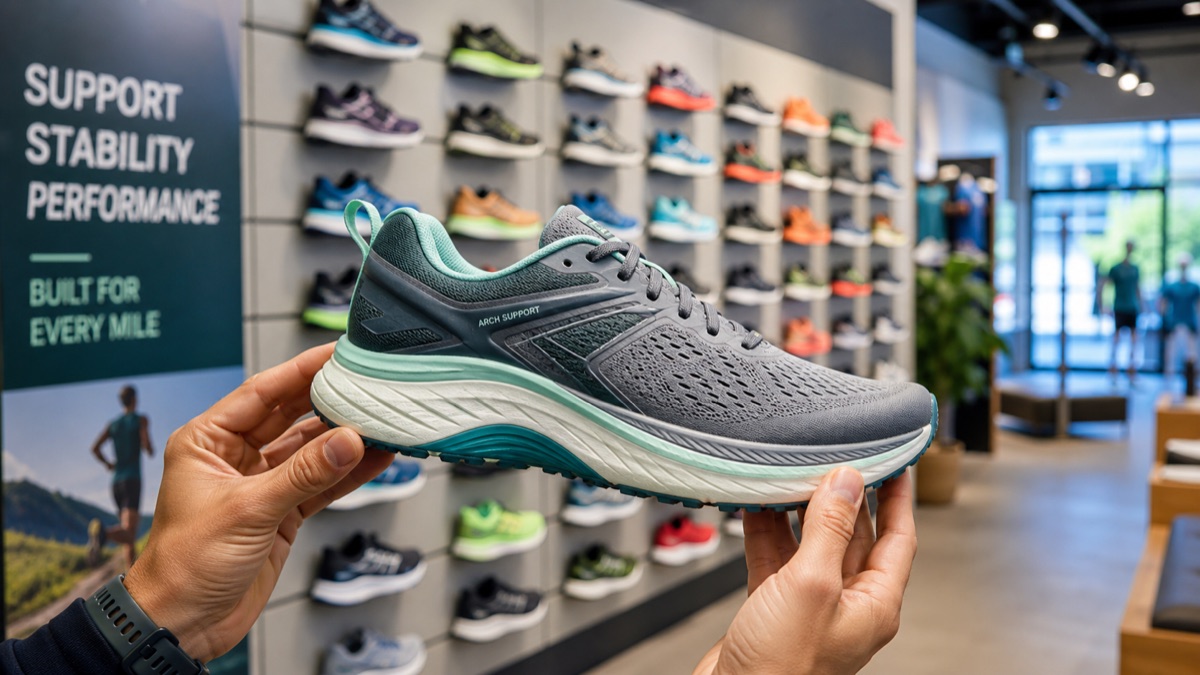
As a sports medicine podiatrist, footwear is one of my most frequently discussed topics with patients — and for good reason. The shoe you put on in the morning is in direct contact with your plantar fascia for 12–16 hours a day. The wrong choice can undo weeks of stretching, physical therapy, and injections. The right choice accelerates recovery and reduces the risk of recurrence. In 2026, the footwear market has evolved significantly, with excellent options across every category — but the fundamentals of what makes a shoe appropriate for plantar fasciitis have not changed. Here is what to look for.
The Key Features That Matter for Plantar Fasciitis
1. Arch Support — Specifically the Medial Longitudinal Arch
The medial longitudinal arch (MLA) is the main arch of the foot — the one you see when you look at the inner profile of a footprint. The plantar fascia runs parallel to this arch and is the primary soft-tissue structure responsible for maintaining it during weight-bearing. When the arch lacks support from the shoe's midsole and insole, the fascia takes on excess load with every step.
Look for shoes with a firm, contoured midsole that rises to support the arch, rather than a flat, compressible foam that allows the arch to collapse. The support should be present when you press on the insole — not just described on the box. Note that "arch support" is not the same for every foot type: flat (pronated) feet need a more aggressive supportive structure that limits inward arch collapse; high-arched (supinated) feet need a more flexible, cushioned support rather than a rigid device. A podiatric evaluation can determine which category your feet fall into.
2. Heel Cup Depth
A deep, well-structured heel cup is one of the most underappreciated features for plantar fasciitis. The heel cup surrounds and compresses the fat pad beneath the calcaneus, concentrating it under the heel where it provides maximum shock absorption. Shallow heel cups allow the fat pad to spread outward during heel strike, dramatically reducing its cushioning effectiveness.
When evaluating a shoe, press your thumb into the heel cup: it should feel firm and structured, not soft and compressible. Look for a heel counter (the rigid structure surrounding the back of the heel) that is stiff enough to maintain the heel cup shape throughout the day. A heel counter that collapses when you squeeze the back of the shoe will provide no meaningful heel containment.
3. Heel-to-Toe Drop (8–12 mm Ideal for Most PF Patients)
Heel-to-toe drop refers to the height difference between the heel and forefoot of a shoe. A shoe with 10 mm of drop means the heel sits 10 mm higher than the toe area. This is relevant for plantar fasciitis because drop directly affects the angle of ankle dorsiflexion during the gait cycle — and the degree of plantar fascial stretch with each step.
For most plantar fasciitis patients, a heel drop of 8–12 mm is the therapeutic sweet spot. This range slightly reduces the stretch on the plantar fascia and Achilles tendon during walking, reducing the inflammatory load on the fascial insertion. Zero-drop or minimal-drop shoes (<4 mm) significantly increase fascial tension and are generally contraindicated during active plantar fasciitis treatment. Traditional running shoes typically offer 8–12 mm of drop; "maximalist" running shoes often fall in this range as well.
4. Cushioning: Rearfoot vs. Forefoot
For plantar fasciitis, rearfoot cushioning is the priority. The heel is the primary site of impact in normal heel-to-toe gait, and it is where the plantar fascia originates. A thick, responsive foam midsole under the heel absorbs impact before it reaches the fascial insertion. Look for multi-density foam construction — a firmer base layer for stability and a softer upper layer for cushioning — rather than a uniform single-density foam that either provides stability or cushioning but not both.
Forefoot cushioning matters for patients who also have metatarsalgia (ball-of-foot pain), but excessive forefoot flexibility can increase fascial stretch during toe-off. A slight degree of forefoot rigidity (often called a "rocker sole" in therapeutic footwear) reduces peak plantar fascia strain during the propulsive phase of gait — a feature commonly found in walking shoes designed for foot pathologies.
5. Toe Box Width
A narrow, pointed toe box compresses the toes and alters the mechanics of toe-off — which, through the "windlass mechanism," directly loads the plantar fascia. Look for a rounded toe box that allows the toes to sit in their natural alignment without compression. There should be approximately a thumb's width of space between the end of your longest toe and the tip of the shoe when standing. Wide or extra-wide sizing is available from many manufacturers and is often worth seeking out for plantar fasciitis patients.
6. Motion Control vs. Neutral: Know Your Foot Type
Motion control shoes feature reinforced medial (inner) midsole structures designed to resist excessive pronation — inward rolling of the foot. They are appropriate for flat-footed patients whose plantar fasciitis is driven by excessive arch collapse and the resultant torsional stress on the fascia.
Neutral shoes provide balanced cushioning without medial reinforcement. They are appropriate for neutral-arched runners and for high-arched, supinated feet (where motion control would actually be harmful, forcing the foot into an unnatural position).
North County active lifestyle note: San Diego's year-round outdoor culture means trail running, beach walks, and year-round sports — which puts unique demands on footwear. Trail running shoes designed for North County terrain (rocky, uneven surfaces like Lake Hodges or Daley Ranch) typically feature more aggressive outsoles and lateral stability features. For plantar fasciitis, prioritize the cushioning, drop, and arch support criteria above even when shopping for trail-specific footwear.
Category-Specific Guidance
Running Shoes
Running shoes for plantar fasciitis should have: 8–12 mm heel drop, substantial rearfoot cushioning (look for thick foam midsoles rated as "maximum cushion" or "plush"), firm medial post or guidance rail if you overpronate, and a structured heel counter. Replace running shoes every 300–500 miles — worn midsole foam loses its cushioning properties long before the outsole shows visible wear, and degraded cushioning is a major risk factor for plantar fasciitis flare-ups.
Walking and Casual Shoes
Walking shoes endure more hours of use than running shoes for most patients. Look for: a semi-rigid or rigid sole (walking shoes flex differently than running shoes — excessive flexibility at the forefoot increases fascial stretch), rocker-bottom geometry if tolerated (reduces peak fascial strain), and a removable insole to accommodate custom orthotics if prescribed.
Work Shoes and Professional Footwear
Hard floors in hospitals, restaurants, retail environments, and warehouses are among the most aggravating surfaces for plantar fasciitis. Work shoes must combine professional appearance with adequate cushioning and support. Look for shoes with a cushioned insole (replaceable with a prescription orthotic), a slight heel elevation (not a flat sole), and a reinforced heel counter. Anti-fatigue insoles designed for long shifts are an acceptable upgrade over stock insoles in work shoes that cannot accommodate custom devices.
Sandals: What Works and What Doesn't
In San Diego's climate, sandals are not a seasonal choice — they are worn year-round, and for plantar fasciitis patients, the wrong sandal can be a significant setback. The key distinction: strapped sandals with a heel strap are far superior to open-back sandals for plantar fasciitis. Heel straps keep the sandal secured to the foot without requiring toe-gripping, which eliminates the intrinsic muscle overactivation that increases fascial tension.
Look for sandals with: a deep heel cup (the most important feature), a contoured footbed that rises under the arch, a firm (not squishy) midsole, and adjustable straps. Avoid open-back slides, pool slides, and conventional flip flops entirely during active plantar fasciitis treatment. Even "orthopedic" flip flops with arch support are inferior to strapped sandals because the open-back design still induces toe-gripping mechanics.
10 Podiatrist-Recommended Shoes for Plantar Fasciitis (2026)
The following shoes meet the clinical criteria above and are recommended by podiatrists for patients with plantar fasciitis. They are organized by use case — running, walking, recovery, and everyday wear — so you can find the right shoe for every part of your day.
HOKA Bondi 9
Brand: HOKA · Model: Bondi 9
Why Podiatrists Recommend It: The Bondi 9 is among the most frequently recommended shoes for plantar fasciitis in clinical practice. Its maximum-cushion, thick midsole acts as a true shock absorber for the heel, dramatically reducing the impact force transmitted to the plantar fascia insertion with each step. The structured heel counter locks the heel in place and prevents fat-pad displacement. HOKA's Bondi line carries the American Podiatric Medical Association (APMA) Seal of Acceptance — a meaningful endorsement that indicates the shoe has been evaluated by podiatric physicians as beneficial to foot health.
ASICS Gel Kayano 32
Brand: ASICS · Model: Gel Kayano 32
Why Podiatrists Recommend It: One of the most recommended stability running shoes for plantar fasciitis patients who overpronate. The Gel Kayano 32 features a firm medial post and a rigid plastic heel cup built into the ankle that prevents inward foot roll — the biomechanical motion that places the most torsional stress on the plantar fascia. Its ASICS GEL technology provides exceptional shock absorption at heel strike, and the high-density foam midsole maintains its cushioning properties over hundreds of miles. Particularly recommended for flat-footed patients whose plantar fasciitis is driven by arch collapse.
HOKA Clifton 10
Brand: HOKA · Model: Clifton 10
Why Podiatrists Recommend It: The Clifton 10's defining feature for plantar fasciitis patients is its signature "meta-rocker" sole — a curved profile that propels the foot forward through the gait cycle, reducing the amount of time body weight rests on the painful heel during toe-off. This rocker geometry also limits the degree to which the plantar fascia must stretch during push-off, reducing peak fascial tension. Like the Bondi, the Clifton 10 carries the APMA Seal of Acceptance. It offers a slightly lighter and more responsive feel than the Bondi while maintaining excellent heel cushioning.
Brooks Adrenaline GTS 25
Brand: Brooks · Model: Adrenaline GTS 25
Why Podiatrists Recommend It: A top-tier stability running and walking shoe that uses Brooks's proprietary "GuideRail" support system — a holistic approach that guides the foot rather than rigidly controlling it. The GuideRails gently prevent excess inward rolling of the ankle and foot without overcorrecting, which takes significant cumulative pressure off both the heel and arch across an entire day of walking. The Adrenaline GTS 25 offers a well-balanced combination of cushioning and medial support, making it suitable for mild-to-moderate overpronators with plantar fasciitis.
OOFOS Ooahh Sandal
Brand: OOFOS · Model: Ooahh Sandal
Why Podiatrists Recommend It: Walking barefoot on hard floors — especially in the morning before the plantar fascia has warmed up — is one of the most common aggravating behaviors for plantar fasciitis patients. The OOFOS Ooahh Sandal is recommended specifically for indoor recovery use because its proprietary OOfoam footbed absorbs 37% more impact than standard foam and distributes pressure evenly across the foot, giving the arches necessary support even for short walks to the kitchen or bathroom. These are the first shoes to reach for when you get out of bed.
KURU Moment
Brand: KURU · Model: Moment
Why Podiatrists Recommend It: Specifically designed for first-step morning heel pain — the hallmark symptom of plantar fasciitis. The KURU Moment features a 12mm heel-to-toe drop that reduces tension on the Achilles tendon and plantar fascia in the relaxed, just-woken-up state. Its deeply contoured KURUSOLE orthotic footbed dynamically flexes with each step to hug the heel and support the arch. Stepping directly into these sandals before your foot touches the floor is one of the simplest, most effective behavioral interventions for reducing the severity of plantar fasciitis morning pain.
Vionic Uptown Loafer
Brand: Vionic · Model: Uptown Loafer
Why Podiatrists Recommend It: You do not have to wear athletic sneakers to manage plantar fasciitis effectively. Vionic is a brand specifically engineered for foot health, and the Uptown Loafer is one of its strongest offerings for everyday professional or casual wear. It features a deep heel cup and a contoured, biomechanical footbed that holds the foot in proper neutral alignment throughout the day — preventing the progressive arch fatigue that causes plantar fasciitis to flare in the afternoon. The APMA Seal of Acceptance confirms its clinical appropriateness for patients with foot conditions.
Dansko XP 2.0
Brand: Dansko · Model: XP 2.0
Why Podiatrists Recommend It: The Dansko XP 2.0 is the go-to recommendation for patients who must stand for extended periods — nurses, teachers, chefs, retail workers, and other professionals on hard floors all day. It features a stabilizing heel counter, a rocker-bottom outsole that reduces calf and fascial loading, and a removable memory foam footbed with robust arch support. The slip-resistant outsole is appropriate for clinical and kitchen environments. Dansko clogs are widely worn in healthcare settings for a reason: they provide genuine clinical-grade foot support during the demands of a 10–12 hour shift.
Vionic Willa 2.0 Slip-On Flat
Brand: Vionic · Model: Willa 2.0 Slip-On Flat
Why Podiatrists Recommend It: Conventional ballet flats and slip-on shoes are among the worst footwear choices for plantar fasciitis — paper-thin soles, no heel cup, and zero arch support. The Vionic Willa 2.0 proves that a stylish flat does not have to damage your feet. Its built-in arch support and deep heel cup maintain proper foot alignment without sacrificing the clean, minimal silhouette of a classic flat. It carries the APMA Seal of Acceptance and is frequently recommended for patients who need a professional or dress option that does not compromise their recovery.
Brooks Ghost Max 3
Brand: Brooks · Model: Ghost Max 3
Why Podiatrists Recommend It: The Ghost Max 3 is specifically recommended for patients managing plantar fasciitis alongside toe joint pain, bunions, or metatarsalgia — a common combination. Its aggressive rocker profile significantly limits how much the toes and plantar fascia must stretch during push-off, reducing total daily fascial strain. The maximum-cushion midsole provides ample shock absorption, and the wide toe box accommodates bunion deformities without compression. For patients with multiple concurrent forefoot and heel conditions, the Ghost Max 3 is one of the most effective all-in-one footwear solutions available.
What to Avoid Completely
- Flip flops: No heel cup, no arch support, zero-drop, and mandatory toe-gripping mechanics. The single worst footwear choice for plantar fasciitis — yet enormously popular in San Diego's beach and casual culture. During active plantar fasciitis treatment, flip flops should be replaced entirely.
- Barefoot and minimalist shoes (<4 mm drop): These shoes are designed to increase foot muscle activation by removing structural support. While appropriate for healthy feet, they dramatically increase plantar fascial loading in patients with existing pathology. Wait until your plantar fasciitis is fully resolved before transitioning to minimalist footwear — and do so very gradually.
- High heels (>2 inches): Elevating the heel shortens the Achilles tendon and plantar fascia through chronic plantarflexion, accelerating the contracture that causes morning heel pain. Moderate heel elevation (1–1.5 inches) is acceptable and may even provide short-term symptom relief; high heels above 2 inches shift load to the forefoot and alter gait mechanics in ways that worsen overall foot biomechanics.
- Worn-out athletic shoes: Midsole foam degrades over time, and a worn-out running shoe may look fine on the outside while providing almost no cushioning or support. If your athletic shoes are more than a year old or have accumulated over 400 miles, replace them regardless of appearance.
- Unsupported flat shoes: Canvas sneakers, ballet flats, and similar flat shoes with thin, non-cushioned soles place the foot directly on a hard, unyielding surface with each step — maximizing impact transmission to the plantar fascia insertion.
When to Upgrade to Custom Orthotics
Over-the-counter insoles can provide meaningful relief for mild plantar fasciitis — particularly if the primary issue is inadequate arch support in otherwise appropriate footwear. However, prescription custom orthotics provide a level of biomechanical precision that prefabricated devices cannot match. They are fabricated from a digital 3D scan of your foot in a non-weight-bearing position, capturing the geometry of your arch, the alignment of your heel, and the flexibility of your midfoot.
At VitaStep, I recommend custom orthotics for: patients who have failed over-the-counter insoles; patients with significant pronation, supination, or leg-length discrepancy; athletes who need sport-specific devices; diabetic patients who require offloading of specific pressure points; and patients whose plantar fasciitis has become chronic. Custom orthotics are transferable between shoes (provided the shoes have removable insoles), making them a versatile, long-term investment in your foot health. Most insurance plans cover custom orthotics with a documented diagnosis — call our office at (760) 546-2220 to verify your benefits.